How U.S. Healthcare Really Broke: An Incentives Framework
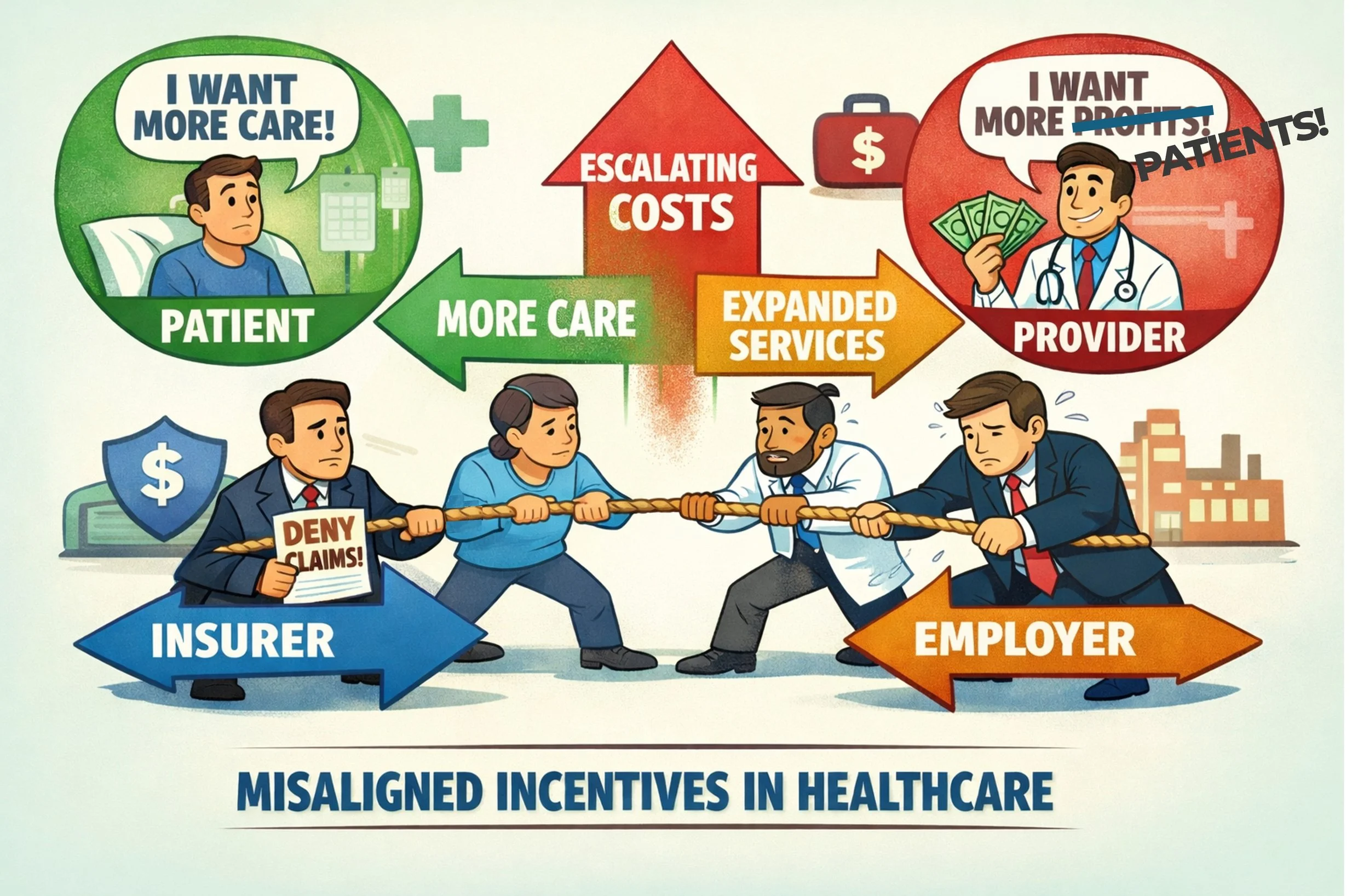
Most healthcare explanations lean on ideology or emotion. Here we examine incentives - how rules, markets, and institutions combine to produce higher costs and growing complexity.
The Goal: Establish criteria to make something better.
What happens when healthcare ideas meet real people, real incentives, and real limits? This paper provides the framework to give the answer.
Instead of judging policies by how they sound on paper or from a microphone, it examines how human behavior and the limitations of time and money shape what actually happens. The goal is to have every healthcare system proposal stress-tested through the same criteria to see whether its promised outcomes are achievable in the real world.
-
Before World War II, U.S. healthcare functioned very differently than it does today. Care was largely paid for directly, prices were visible, and insurance played a limited, targeted role. Decisions during the war effort - not deliberate design - changed the trajectory. We were still dealing with these consequences today.
-
Our not seeing healthcare prices is often treated as a failure of transparency or technology. This section explains why it is neither. Instead, hidden prices persist because they serves the interest of multiple market players - including some that will likely surprise you. Price opacity is not accidental; it is a stable incentive equilibrium. Understanding why prices remain hidden is essential to understanding why cost control efforts repeatedly fail.
-
Public debates about healthcare are dominated by familiar claims: insurers are the problem, profits drive costs, administrative waste is the main inefficiency, or markets simply “don’t work” in healthcare. This section examines those narratives against incentives, historical evidence, and observed outcomes. The goal is to separate what sounds persuasive from what actually explains system behavior.
-
Quality is often invoked as the solution to healthcare’s cost problem - but measuring it is much easier said than done. This section explains why along with how this struggle to measure quality rarely disciplines cost the way policymakers expect (and promise).
-
The Affordable Care Act is often framed as either a corrective reset or a partisan failure. This section takes a different approach. It explains how the ACA interacted with existing structures to offer broader coverage alongside accelerated underlying cost growth.
-
Subsidies are widely assumed to make healthcare more affordable. This section explains why they often do the opposite. By insulating consumers from price while preserving underlying cost structures, subsidies shift who pays rather than what things cost. The consequences create escalating problems that simply increasing the subsidy amount will never solve.
-
Calling healthcare a right expresses compassion, but it does not eliminate scarcity, cost, or tradeoffs. This section examines what rights language implies when applied to the necessary components that make providing healthcare possible. The goal reconcile moral expectations with unavoidable constraints - and what happens when that reconciliation is avoided.
-
Hybrid systems attempt to combine market choice with centralized control, promising the benefits of both. In practice, they often have core elements that work against each other. This section explains why hybrids fail predictably - not because compromise is flawed, but because mismatched incentives leave no one clearly responsible when tradeoffs surface. The U.S. today is a hybrid system.
Healthcare Discussion Topics
Sample sections are below: Learn how they combine to paint the full picture of U.S. healthcare in the complete document.